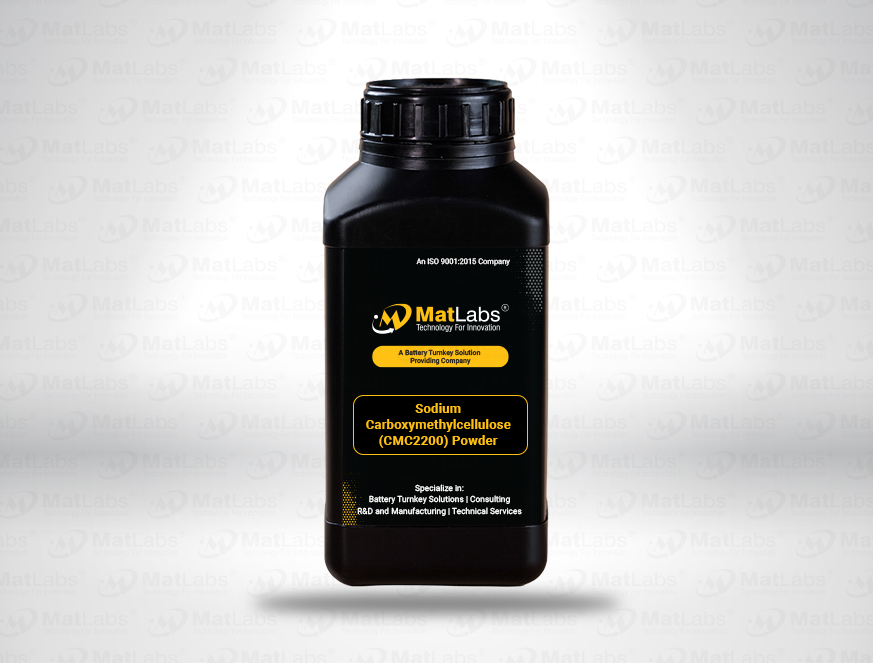
Sodium Carboxymethylcellulose (CMC) Powder
Premium Sodium Carboxymethylcellulose (CMC) Powder — a high-quality, water-soluble binder and rheology modifier designed for lithium-ion battery electrode slurries. With excellent dispersion, viscosity control, and adhesion properties, this CMC powder enhances slurry stability and electrode performance in anode formulations.
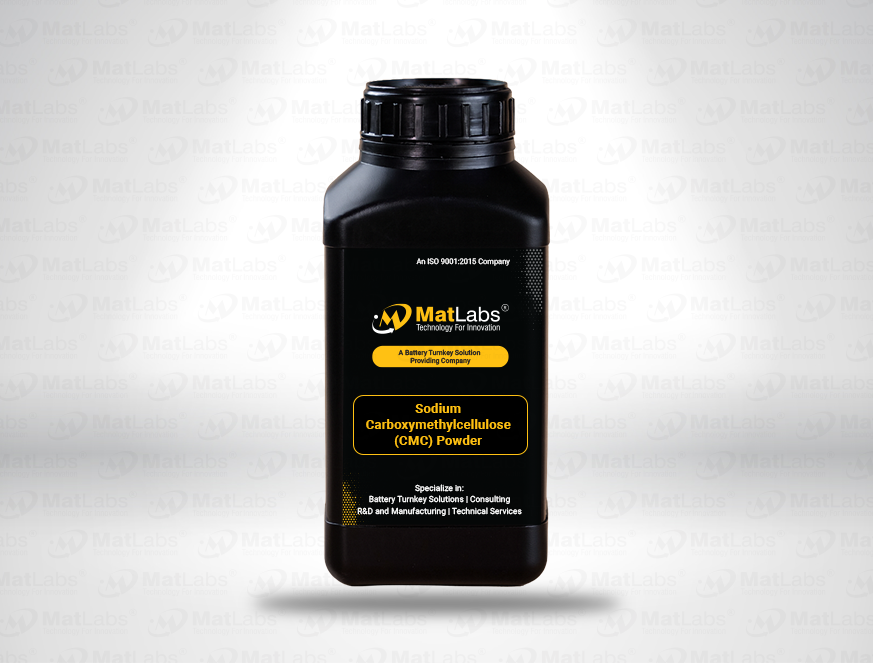
Product Code: MT-MAT-2025
Product Overview
Matlabs Technologies’ Sodium Carboxymethylcellulose (CMC) Powder is a versatile, high-performance water-soluble binder and rheology control agent widely used in lithium-ion battery anode formulations. When combined with Styrene-Butadiene Rubber (SBR), CMC improves slurry viscosity, adhesion, and coating quality — resulting in enhanced electrode integrity and cycling stability. ([research articles])
This powder helps regulate slurry flow behavior and promotes uniform coating on current collectors, making it essential for scalable and reproducible electrode manufacturing.
Features & Benefits
• Excellent Water Solubility – Rapid and uniform dispersion in aqueous systems.
• Rheology Control – Enhances slurry viscosity and stability for consistent coating.
• Strong Adhesion – Helps bind active materials and conductive additives together.
• Compatible with SBR – Works synergistically with SBR binders to improve electrode performance.
• Eco-Friendly Processing – Supports water-based electrode manufacturing without toxic solvents.
Applications
- Lithium-Ion Battery Anode Slurries – Enhances electrode slurry structure and performance.
- Water-Based Electrode Manufacturing – Ideal for green processing methods.
- Battery R&D & Prototype Testing – Supports formulation optimization.
- Electrode Coating Lines – Improves uniformity and mechanical consistency.
Usage & Handling
To prepare battery slurries, CMC powder is typically dissolved in water and blended with active materials, conductive additives, and SBR binder. Proper mixing ensures uniform dispersion and prevents agglomeration. This approach enhances mechanical strength and long-term cycling performance of the electrodes.
Storage: Keep in a cool, dry environment. Seal packaging to prevent moisture absorption and caking.